I depart the train in Gorakhpur, India and hail a jeep driver. When he decides not to go any further, I get out and walk half a mile to the India Nepal border crossing at Sunauli. Swarms of pedestrians are walking or riding on bicycles, rickshaws and motorcycles towards the border. Across two square columns a banner reads: “Indian Border Ends.” I get my passport departure stamp at the India Immigration office. On the Nepal side painted on a cupola are a trio of Buddha eyes casting down on us. Two of the eyes are said to see the material world while the third much smaller eye sees wisdom and truth. I straddle one leg in India and the other in Nepal. “It’s possible to be in two places at one time,” I joke to passersby. Just steps away I receive a visa from the Nepal immigration office after having filled out required forms previously in the U.S.
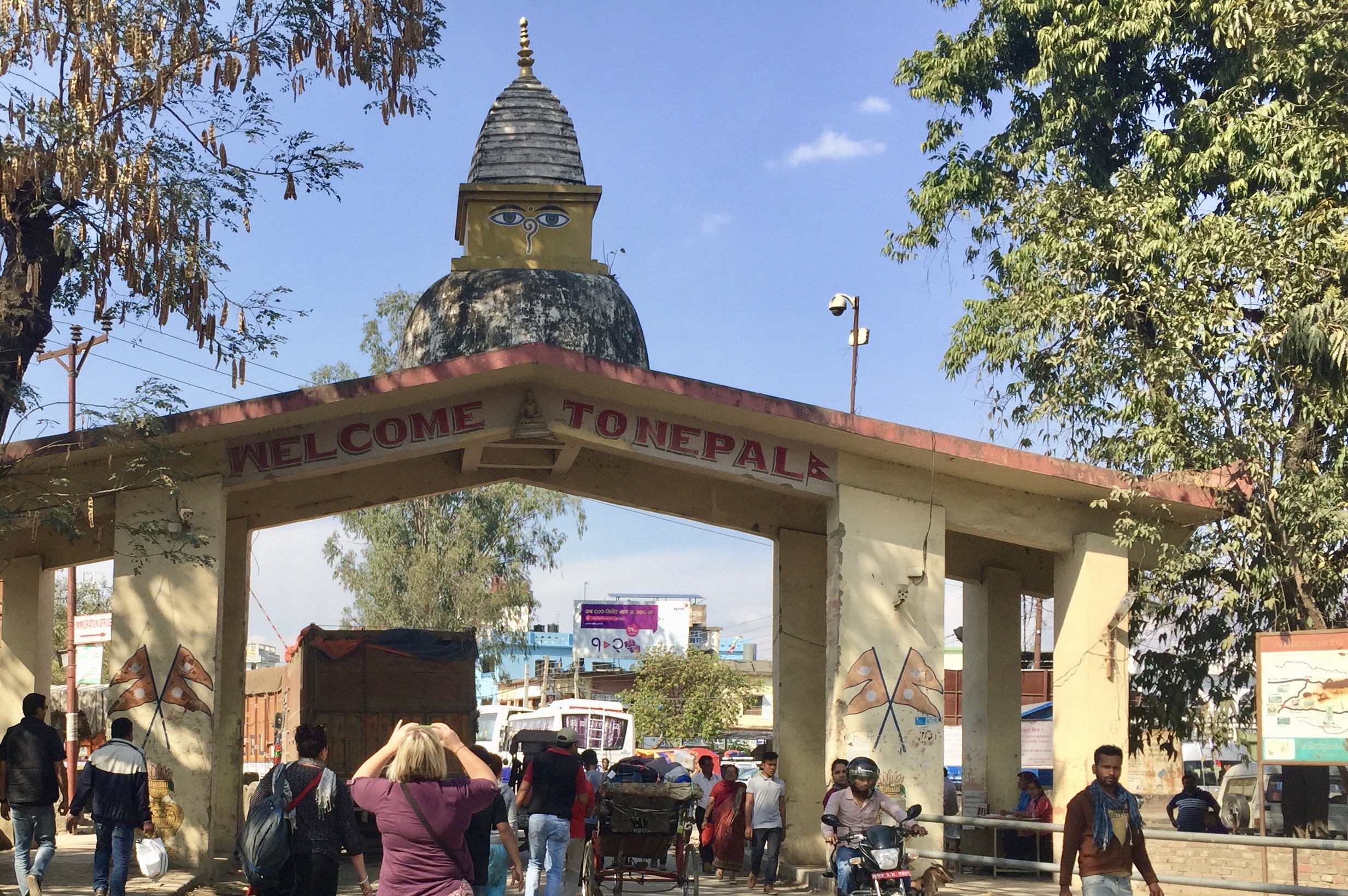
Approaching the border crossing into Nepal
I get into a van with other folks heading towards Lumbini, the birthplace of Buddha. The landscape is tranquil. It’s like a ghost town compared with India. Open fields stretch for miles to a shadowy mountain range in the distance, the Himalaya. A single pole waves the country’s flag. Nepal is the only country with a non-rectangular flag. It’s shape is comprised of two stacked triangles.
Our first stop is the Nipponzan Myohoji World Peace Pagoda. Three levels surround the white dome building. At its base are four sculptures depicting the life of Buddha, each facing one of the cardinal directions. Japanese Buddhist monks designed the building’s pagoda. People walk with reverence around it.
Lumbini, Birthplace of Buddha
Lumbini is to Buddhists what Bethlehem is to Christians, or Mecca is to Muslims – a holy place. There is some difference. When people want peace, they can lean toward faith traditions or find their own peace within, the way Buddha did. The Buddhist way is through one’s self, not a religious deity.
Maya Devi Temple, the place of Buddha’s birth is a UNESCO World Heritage site. Colorful prayer flags wave in the gentle breeze. The building lies like a bunker in the foothills of the Himalaya. Mottled bricks indicate a long history. We follow its ancient walls to the very spot where it is believed Queen Mayadevi gave birth in 249 BC while traveling to her parent’s home. The temple was built over the site to protect the relics. I was surprised to learn that both Jesus and Buddha were born to traveling mothers.
I walk over to the pool of water where the Queen mother bathed before giving birth and rest under the prayer flags.
At the nearby Lumbini Heritage Park excavated remains of monasteries and memorial shrines date from the 3rd century BC. In the Park, Buddhist monasteries depict the architectural style of the country or region represented. Notably missing is the United States. Representing North America are Canada and Mexico.
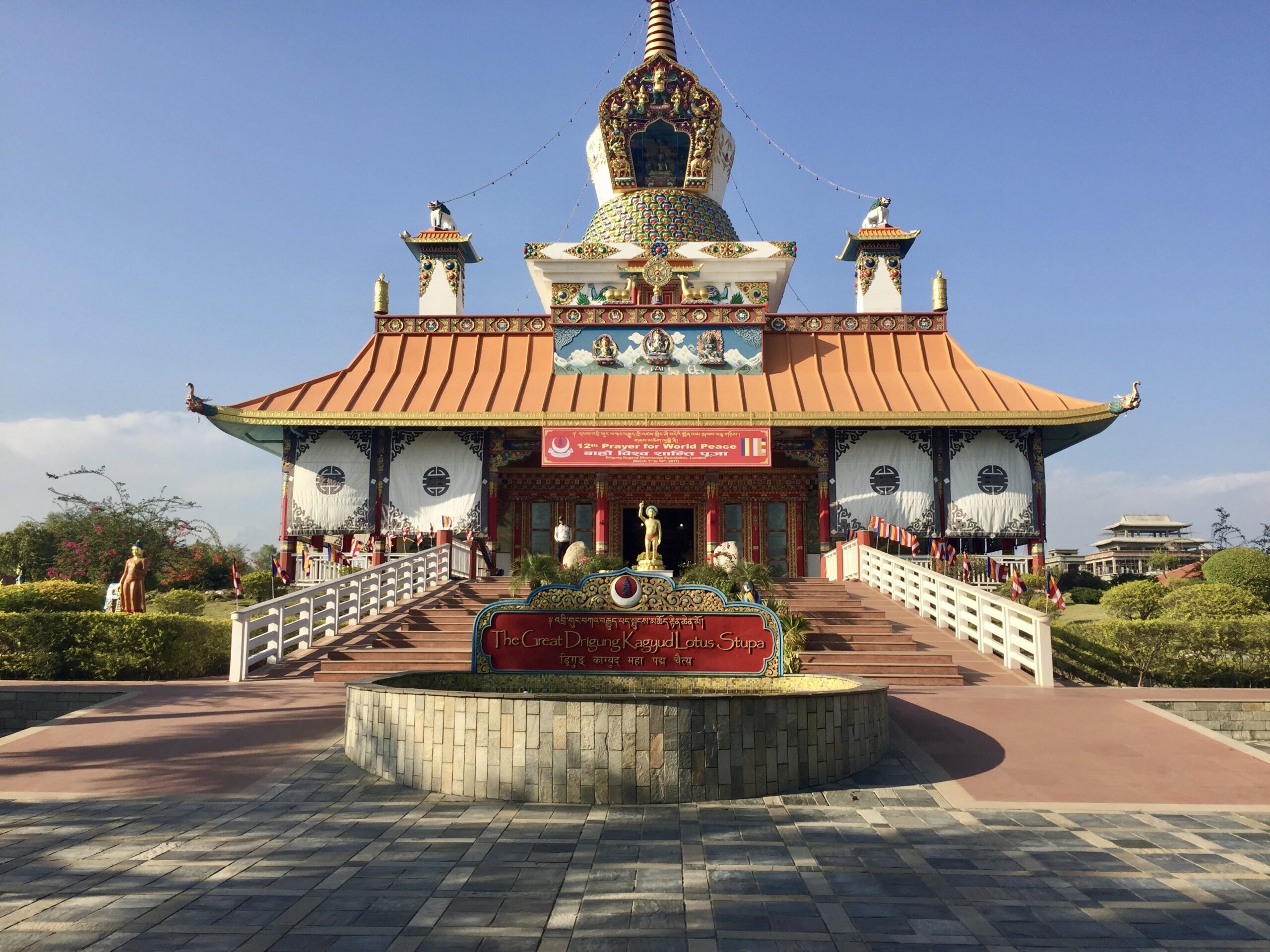
Stupa at Lumbini Heritage Park
River and Jungle Safari in Chitwan National Park
When I arrive in Chitwan I see young men riding on the backs of elephants and others on the seats of motorcycles. The town shops are filled with colorful textiles and ceramics all made in Nepal. The shopkeepers are friendly and proud of their wares.
This feel-good welcome continues when I meet Fule Chaudhary, the guide who will take me and a handful of travelers through Chitwan National Park. We are staying on Park grounds in quaint, clean rooms that look like little houses but contain only two beds and a bathroom. Fule’s eyes are kind and keen. A continuous smile stretches across his round face. He’s wearing a forest green shirt and green pants. I take out my notebook and jot down some of what he is telling us about the Park – First national park in Nepal, world heritage property, two kinds of crocodile – gharial and mars mugger; 632 species of birds, Sal (Shorea robusta) forest; home to horned rhinoceros and Bengal tiger. Best way to avoid a charging rhino is to hide behind a tree.
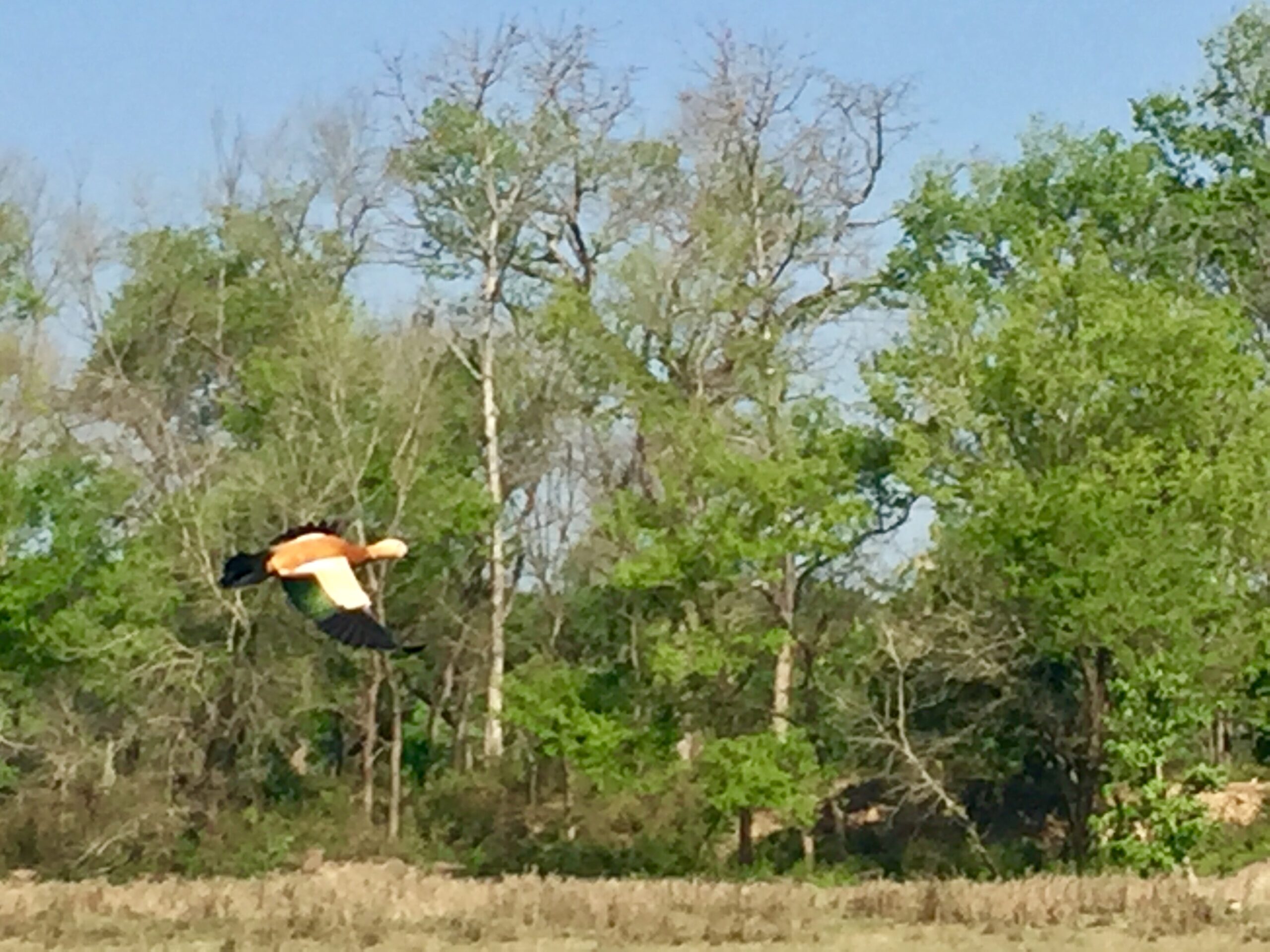
Bird in flight at Chitwan National Park
The sun is hot in mid-day. I question going out at this time. “Aren’t safaris supposed to happen during the morning or early evening hours, when it’s cooler and the animals come out to eat?” Fulé laughs. “That’s what people think. It’s why the area gets congested with jeeps and no one sees anything. The animals don’t want to see us as much as we want to see them.” I remember the traffic jams from past safari trips and let my thought go. There is no fakery about Fulé. He knows what he’s doing.
Before we set out, Fulé tells us to wear brown or green clothes to blend with the forest. He shows us hand signals he will use upon sighting an animal. He doesn’t like to verbally announce their presence as it could startle an animal. We are guests, not intruders. Fule’s favored mode of transportation is a long, shallow dug-out canoe carved from a Champ tree.
“The canoe requires balance while on the Rapti River so be careful,” he explains as we load ourselves into the narrow vessel. The birds are the first creatures I notice. Then the sun-dried crocodiles lying on rocks with their opened V-shaped mouths showing rows of serrated teeth. The red-orange blossoms hanging on branches of the Kapo trees remind me that it is spring.
“What are the worn paths leading to the river from?” I ask. Fulé gives the hand signal for rhino. He flashes a smile at my observation. “They come to the river to drink.”
Except for a few bird calls, it is quiet. We drift easily in the secluded river’s slow current. Sitting at the head of the canoe, Fulé again signals rhino. The creature is poking his head out from the brush staring at us. “They are real,” I whisper.
“It’s a male,” Fulé says. “They are heavier with a thicker, shorter horn than females. More aggressive in protecting their territory too.”
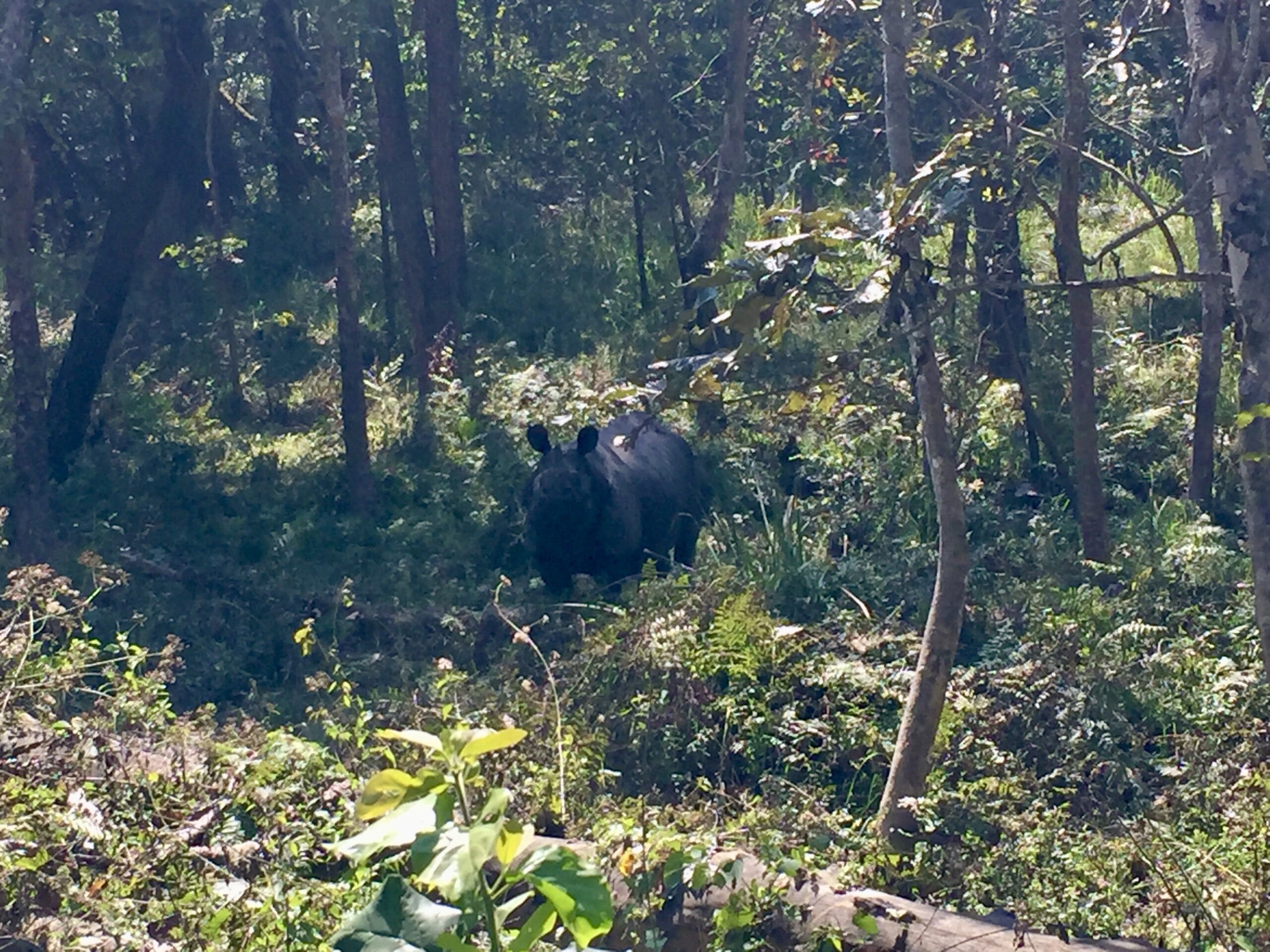
One horned rhino in Chitwan National Park
Minutes later, we see a herd of water buffalo on the west bank of the river, but Fulé signals tiger. On the east bank the wild cat stands in prowl position. Slivers of black stripes cross his back. He approaches the water with a slouch. None of us moves. We watch the tiger slip into the river without a splash and paddle across, keeping his pudgy head and whiskers above the water.
The water buffalo scatter. Fulé steers the canoe to the shoreline and listens. He breaks the silence with a hushed voice. “Let’s wait and see if the tiger comes back.” We sit quietly for about 20 minutes, then float on when the tiger doesn’t return.
Fulé tells us he hasn’t seen a tiger in the Park for several years. With joy in his voice, he announces: “It’s an auspicious day.” Our awe lingers as we bank the canoe and travel by jeep through the jungle. We see multiple rhinos aim their horns towards us, elephants lingering, and playful monkeys swinging in trees. What we don’t see is another human or jeep throughout the day.
We lodge near the river with a multi-generational family that rents rooms in an outbuilding just feet from their home. We borrow bicycles and ride through a part of town we haven’t seen yet. We stop to talk with a farmer in his field who is growing red lentil seeds.
Celebrating Holi
Unbeknownst to me the next day is Holi, the Hindu festival of color that celebrates good over evil and the promise of spring. I had seen photographs of people celebrating Holi in National Geographic magazine when I was a teenager. Now here I am, celebrating Holi in Nepal. The shops are decorated with marigolds to celebrate the holiday. Shop owners rub smudges of colors on my forehead for what reason I do not know. I am unaware of what to expect on Holi but enjoy the festive mood everywhere I go.
When I arrive back at the house, the sun’s light has dimmed its bravado and hovers casting pastel colors across the horizon. The grandmother in the family where I am staying wears an apron around her waist and smiles graciously. She listens attentively to our accents as we greet her. A little girl around age seven teases us swinging a lei of marigolds. She wants to wrap it around my neck, but I am too tall for her to reach. I bow so she can complete her task. She follows with a laugh.
One of the other guests is a disk jockey from London named Paul. He prefers to be called his stage name, “Pig.” He sits under the gazebo with a bottle of beer. He lets us know he doesn’t want to participate in any holiday rituals. Everyone else seems ready to go along with anything and anyone. Pig sulks. Dinner under a canopy fills our stomachs with homemade boiled cabbage, lentils, eggs, curry and chapatis. Glasses of mint lemonade and chai tea quench our thirst. I hadn’t eaten meat for weeks and didn’t miss it.
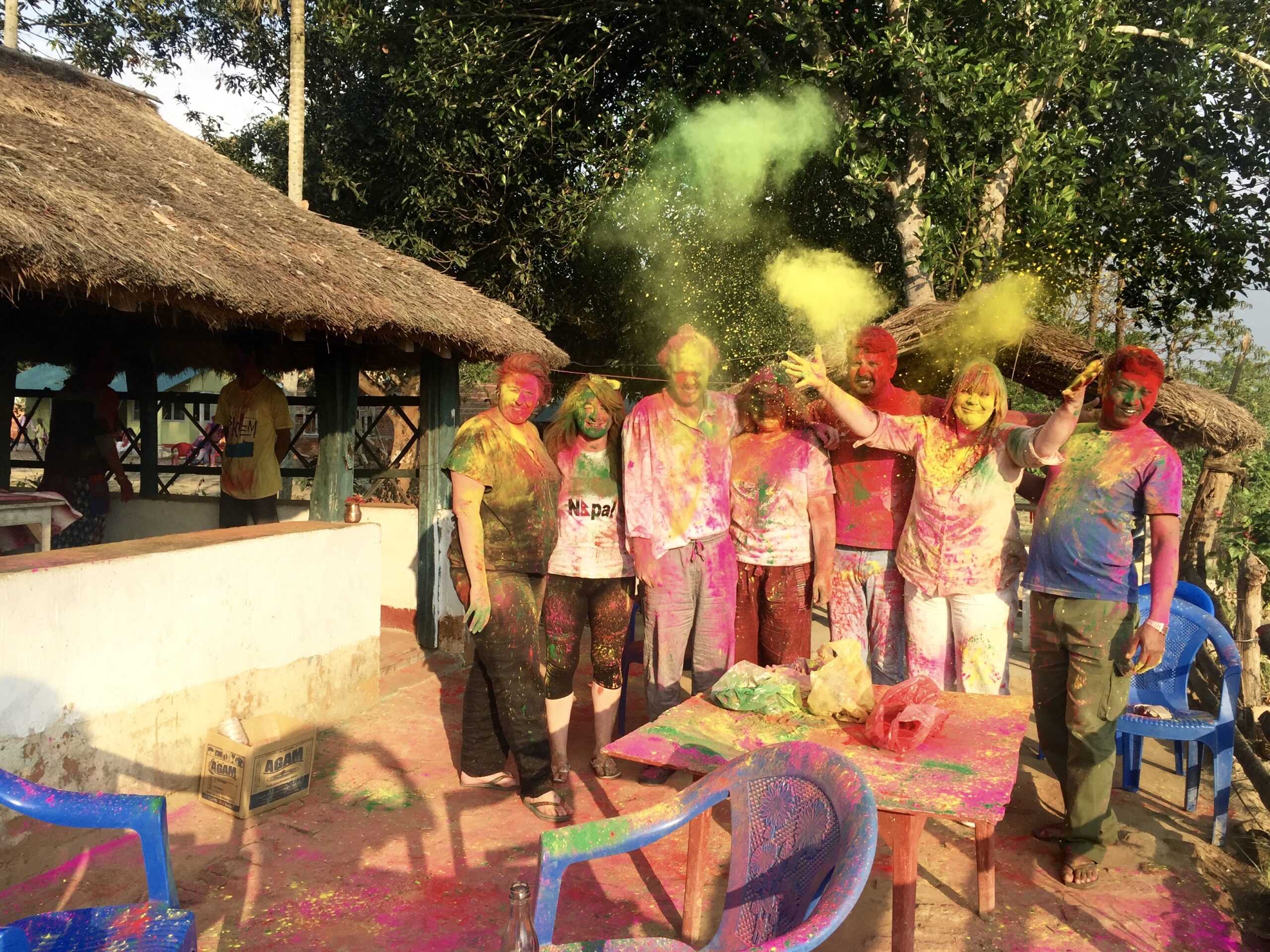
Celebrating Holi in Chitwan, Nepal
After dinner a large tray of powdered colors appears. We whip the clouds of rainbow colors into the air covering our faces and clothes. Neighbors come out and join the jubilation. The music shifts from Bollywood to American Country to Korean pop. We dance joyfully in sync to PSY’s Gangnam style dressed in our now multi-colored clothes.
Later while washing my clothes in the sink, I promise: “I’m going to celebrate Holi every year.”
Alleys and Valleys of Kathmandu
I leave Chitwan for Kathmandu early the next morning. The van rocks as it climbs through the Himalaya mountains on narrow, under-construction rutted dirt roads. It is a scary balancing act. Of Kathmandu I had some expectations. I envisioned a valley paradise like the one in the 1937 Capra film, Lost Horizon. I did not find that. Many buildings in the city are still crumbled and in need of repair from the earthquake that hit in 2015. However, Durbar Square and the city’s maze of alleys make it intriguing.
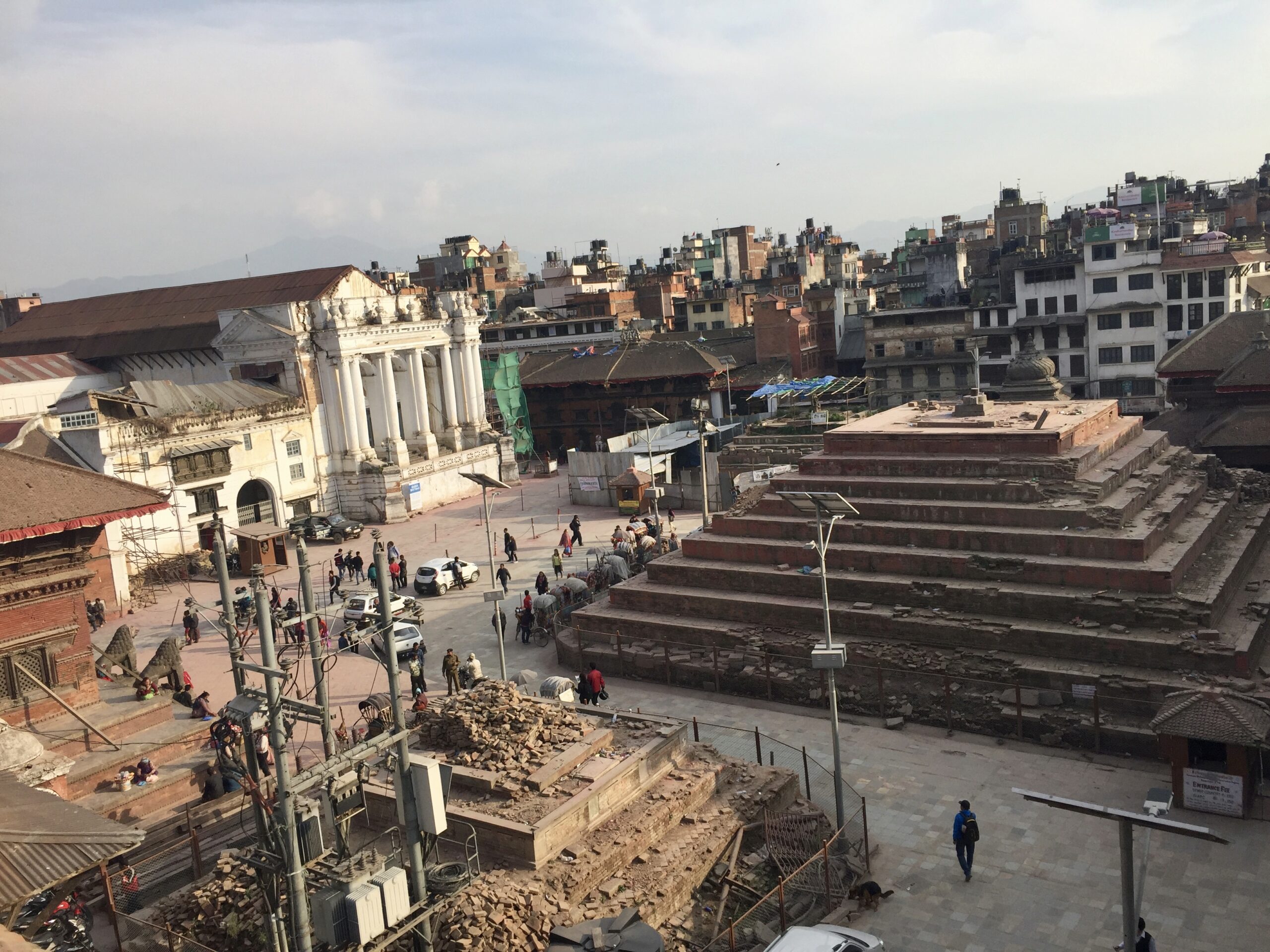
Durbar Square in Kathmandu
It is in this half-wrecked valley city, with its thin air turned thick with pollution, that I recognize the rhythm of life. It’s not meeting for lunch or attending an event. It’s where we go, what we eat or don’t eat; what we read, listen to, or observe during the day; who we talk with and reach out to, our reactions to irritants and surprises, who or what we are curious about, feel responsible for, say goodnight to.
Unfortunately, travel adventures must end. I don’t walk out of Nepal. After weaving through Kathmandu’s street markets, stopping at the serene Garden of Dreams and the dusty, dark Kaiser Library I board an airplane that climbs and climbs until we’re higher than the Himalaya.
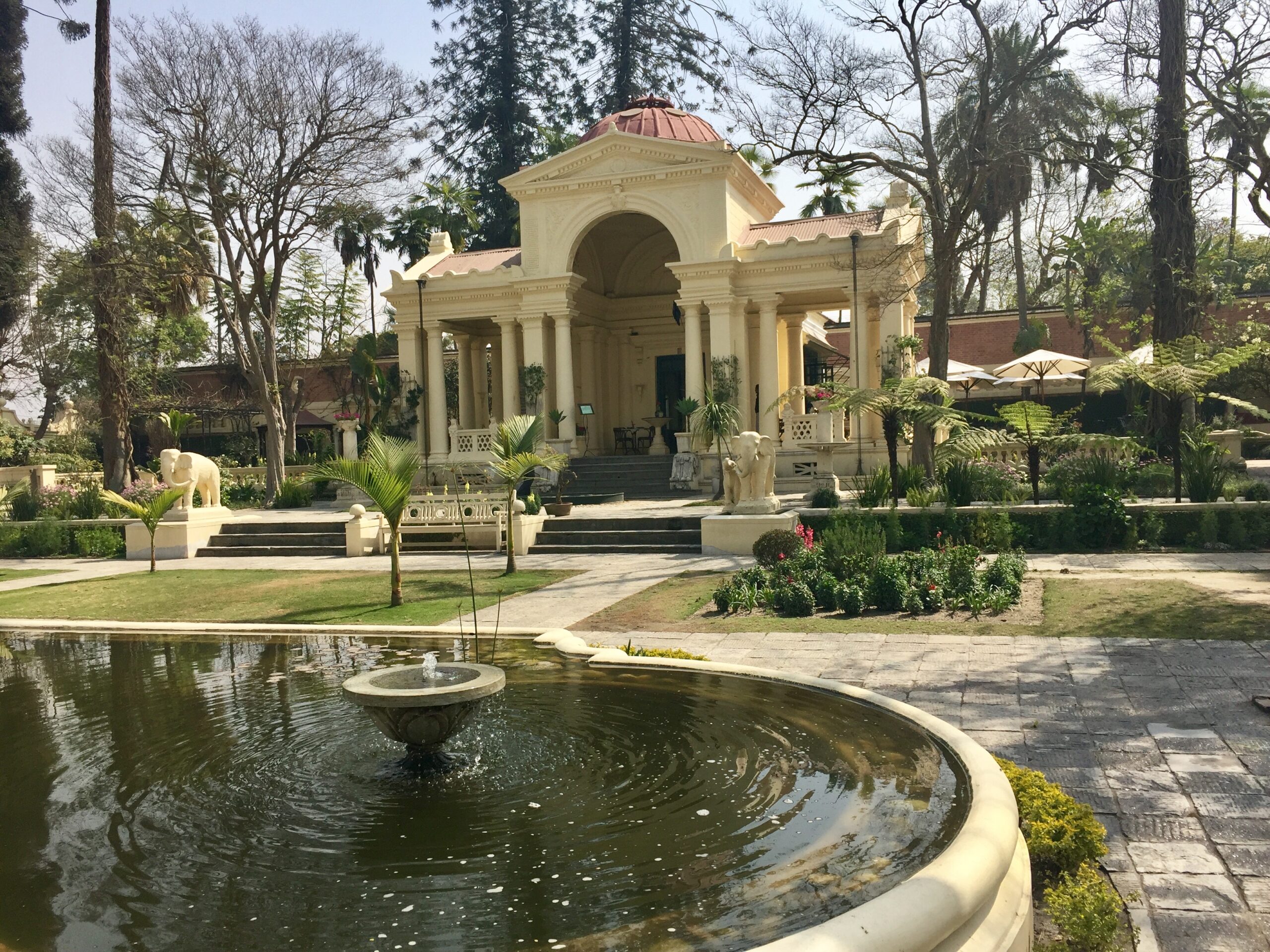
Serenity prevails at the Garden of Dreams in Kathmandu